

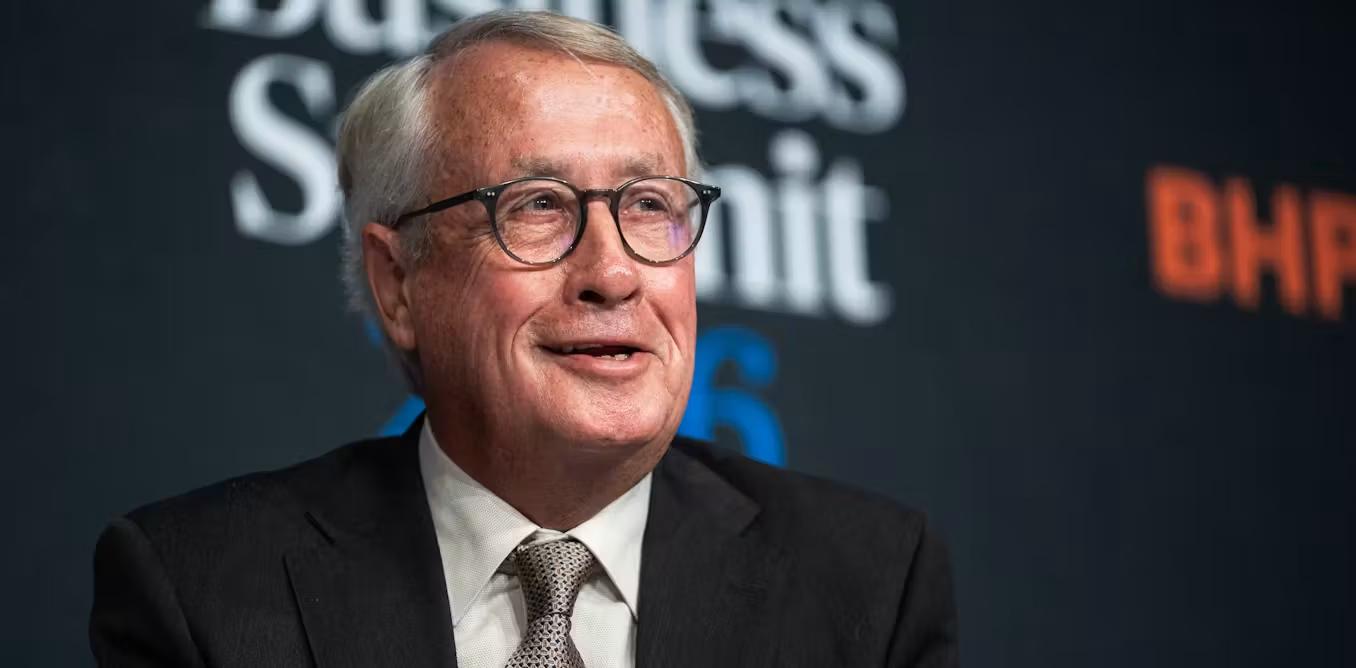
Next week, Labor will hold its 50th national conference in Adelaide. After the party’s record 94-seat win at last year’s federal election, its members should have plenty to celebrate. Yet since that election, both Labor and the Coalition have watched their support erode, largely in favour of One Nation.
Labor’s national president, Wayne Swan, saw the danger signs last year.
Swan was treasurer in the Rudd-Gillard government, including through the global financial crisis. He was also deputy prime minister, and previously led Wayne Goss’s 1989 Queensland election campaign, ending three decades of conservative reign in the state.
Soon after last year’s landslide, Swan issued a clear-eyed warning that Labor’s victory was “wide but shallow”. Despite its strong showing, he pointed out that Labor had “simply failed to secure strong support from lower-income, lower-educated Australians” – once a core part of its voter base.
At next week’s conference, after eight years in the job, Swan will pass on the party presidency to former federal minister Kate Ellis.
Swan joined us on the podcast to discuss living in a time of “dramatic insecurity”, voter volatility, artificial intelligence (AI) and more.
‘A dramatically different contest’
Asked about his “wide but shallow” warning, Swan said it was prompted by seeing the two major parties win just two-thirds of last year’s vote, while the remainder was already “splintering around the edges”.
Since I made those remarks, of course, we’ve seen the rise of One Nation. And it has eaten the lunch, if you like, of the conservative parties. And the race now is really between Labor on the one hand and a clutch of right-wing parties – including One Nation, the Liberal Party and the National Party – on the other.
That’s a dramatically different contest from what we’ve been used to over many years. And it is one in which it’s critically important to secure your base level of support in the community […] So with a majority of 53% or 54% of the two-party vote, in the last election we achieved a record 94 seats. But it wouldn’t take too much of a fall in the primary vote for those seats to evaporate.
Voter volatility and anxiety
So has Labor reached the lowest point of its primary vote – or could it fall further? Swan said Labor needs to keep showing it’s focused on helping with cost-of-living pressures.
I don’t think we could ever take any vote for granted, in that we live in a time of anxiety, of dramatic insecurity, both in terms of economic outlooks and the security outlook. And that has been reflected in, if you like, the volatility in politics, not just in Australia, but also around the world.
That’s why [… it’s] so important for us to demonstrate that we understand the need for fundamental change, particularly in our economy and in our society. And that we have to respond to cost-of-living increases, which are putting many people in the Australian community under tremendous financial pressure.
So for us at this conference, we have the demonstrate that we as a labour movement, and a Labor Party, are delivering real change and addressing the issues which are putting Australians under financial pressure.
On the rise of AI
Productivity has been low across much of the Western world, including in Australia. Swan said AI was “an important part of technological innovation”, leading to gains in productivity over time.
But is he optimistic or worried about the rapid rise of AI in Australia and globally?
Well, I’m both. AI is going to revolutionise any number of public policies and approaches and frameworks within the workforce and within the wider community. It’s not one that can be stopped […] As is the case with all big social and economic challenges, there needs to be a policy framework which ensures that the public interest is protected, that the economic gains are spread as widely as possible, and that the maximum amount it delivers to our prosperity is extracted from it.
On needing to serve retirees better
Swan is now the chairman of one of Australia’s largest industry superannuation funds, CBUS Super.
After appearing at a superannuation roundtable alongside the architect of the A$4.5 trillion superannuation sector, Paul Keating, Swan described the mood in the room.
I think the feeling in that discussion was highly optimistic about the contribution that the Australian superannuation industry can make over a period of time, not just to the wellbeing and retirement of our members, but also to the prosperity of our economy.
You might well recall that during the global financial crisis, it was the superannuation funds that recapitalised the private sector in Australia during a period of huge stress. That didn’t involve any government direction, or any change in government policy. What was really highlighted was the extent to which our $4 trillion savings pool is a huge economic asset for the country, a cushion, if you like, for the economy.
Around 2.5 million Australians are expected to retire over the next decade, in what’s been dubbed a coming “silver tsunami”.
Over the next few years, Swan said all super funds will need to get better at serving Australians well into retirement.
What was highlighted at the discussion was the need for all funds to be much more active in what’s called the ‘retirement phase’ of superannuation. That is, superannuation is now 40 years old and the first people that came into it at the very beginning are either in retirement or contemplating retirement.
The implication of that for most funds is for them to be far more active in working with, and advising their members about, what their options are when they retire.
Michelle Grattan does not work for, consult, own shares in or receive funding from any company or organisation that would benefit from this article, and has disclosed no relevant affiliations beyond their academic appointment.
Click here to view the original article.
Author/s: Michelle Grattan, Professorial Fellow, University of Canberra
