

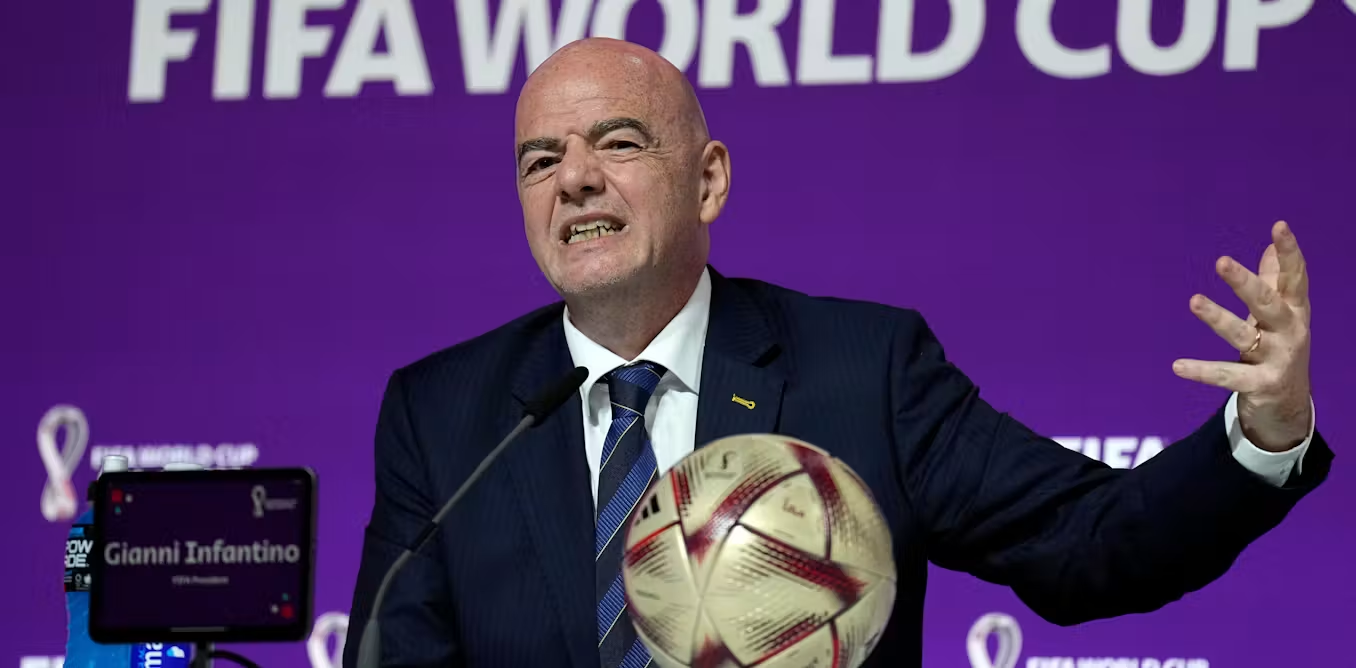
After one of the most turbulent and controversial few days in the history of world soccer, the future of FIFA and its leader Gianni Infantino are under intense scrutiny.
FIFA’s proposal to create a new commercial entity, FIFA Forward Enterprise (FFE), collapsed after an extraordinary backlash from across the world.
The plan would have created a US$20 billion company to run the World Cup with private investors. Soon after news of it was released, European soccer’s governing body UEFA threatened to boycott the World Cup and all other FIFA competitions.
What began as a technical restructuring initiative quickly escalated into a political confrontation that exposed deep institutional fractures within the global governing body.
Read more:
World game at war: why some European nations have threatened a World Cup boycott
So, why was there such fierce backlash and what may happen from here?
The backlash against FIFA, Infantino
UEFA was the first to intervene, warning the plan amounted to an unacceptable privatisation of the World Cup.
The Confederation of North, Central American and Caribbean Association Football (CONCACAF) followed with its own formal rejection. It emphasised the proposal lacked transparency and embedded private investors within FIFA’s commercial decision-making.
When the Asian Football Confederation (AFC), of which Australia is a member, also announced its opposition, the arithmetic became decisive: UEFA’s 55 members, CONCACAF’s 35 and Asia’s 46 represented a potential bloc of 136 votes. This is well beyond the 106 required to block the proposal.
Despite this, FIFA initially insisted “nobody is selling football”, even as internal dissent intensified.
Carlos Cordeiro, Infantino’s senior adviser on global strategy and governance, resigned, describing the proposal as “a bad deal for football” that would “mortgage football’s future”.
FIFA’s chief operating officer Kevin Lamour stated the administration had been “deceived”.
Only once it became clear the proposal could not pass did Infantino announce it had been scrapped. He acknowledged it had “created divisions” that were “no longer in the interest” of its stated objectives.
Soccer as a public good?
The collapse of FFE reframed the controversy from a failed commercial initiative into a moment that calls Infantino’s leadership into question.
With his next presidential election scheduled for 2027, the episode has exposed a widening gap between Infantino’s strategic ambitions and the expectations of FIFA’s member associations.
FIFA is, at least in principle, a public-interest organisation, and soccer itself is widely understood as a global public good.
Its legitimacy depends on collective governance, equitable access and stewardship rather than financial engineering or investor-driven priorities.
The attempt to embed private capital within FIFA’s commercial core, despite internal warnings and external opposition, suggests a strategy driven less by the long-term interests of the game and more by political reasons.
There is growing number of member associations now suggesting the episode exposes a deeper structural problem: a presidency increasingly oriented toward consolidating authority rather than safeguarding the sport’s public-interest mission.
The willingness to advance a proposal that fractured confederations, alienated senior advisers and risked FIFA’s legitimacy has intensified scrutiny of whether Infantino’s leadership remains viable.
Who could be next in line?
The collapse of the proposal has sharpened attention on whether alternative leadership might emerge.
Aleksander Čeferin, the UEFA president, stands out as the most authoritative institutional critic of the proposal, having positioned UEFA as the central counterweight to FIFA’s commercial ambitions.
His leadership during the confrontation reinforced his status as one of the few people capable of challenging Infantino.
Nasser Al-Khelaifi, President of French powerhouse Paris Saint-Germain and chair of the European Club Association, is another influential figure. He may be capable of mobilising political support across European and Middle Eastern soccer.
Reformist Dariusz Mioduski, owner of Legia Warsaw and a board member of the European Club Association, is another possible candidate.
Mioduski could be supported by a coalition of influential national associations – including Bosnian, Norwegian, Swedish, German and Spanish federations – signalling parts of Europe may be prepared to coalesce around a reform-minded candidate rather than rely solely on established federation leaders.
Victor Montagliani, president of CONCACAF, is emerging as the most likely challenger from outside Europe.
A Canadian business leader and long-serving soccer executive, Montagliani has led the confederation since 2016. His strong institutional backing across North and Central America has positioned him as a credible candidate should the political environment shift.
An uncertain future
As FIFA approaches the 2027 presidency election, the question is no longer simply whether Infantino can secure the votes required to remain in office, but whether world soccer is prepared to endorse a model of governance that appears increasingly shaped by political survival rather than the long-term health of the game.
But it would be naïve to assume the project is truly finished.
The proposal was withdrawn only once it became mathematically impossible to pass. Its underlying logic – centralising commercial authority and embedding private capital within FIFA’s core – remains aligned with Infantino’s broader strategic trajectory.
Should he be re-elected and feel less politically vulnerable, there is a possibility he may seek to reignite the initiative. If so, that would raise further concerns about whether his leadership is oriented toward safeguarding soccer’s public-interest mission or consolidating his own authority.
James Skinner does not work for, consult, own shares in or receive funding from any company or organisation that would benefit from this article, and has disclosed no relevant affiliations beyond their academic appointment.
Click here to view the original article.
Author/s: James Skinner, Dean Newcastle Business School/Professor of Sport Business, University of Newcastle
