

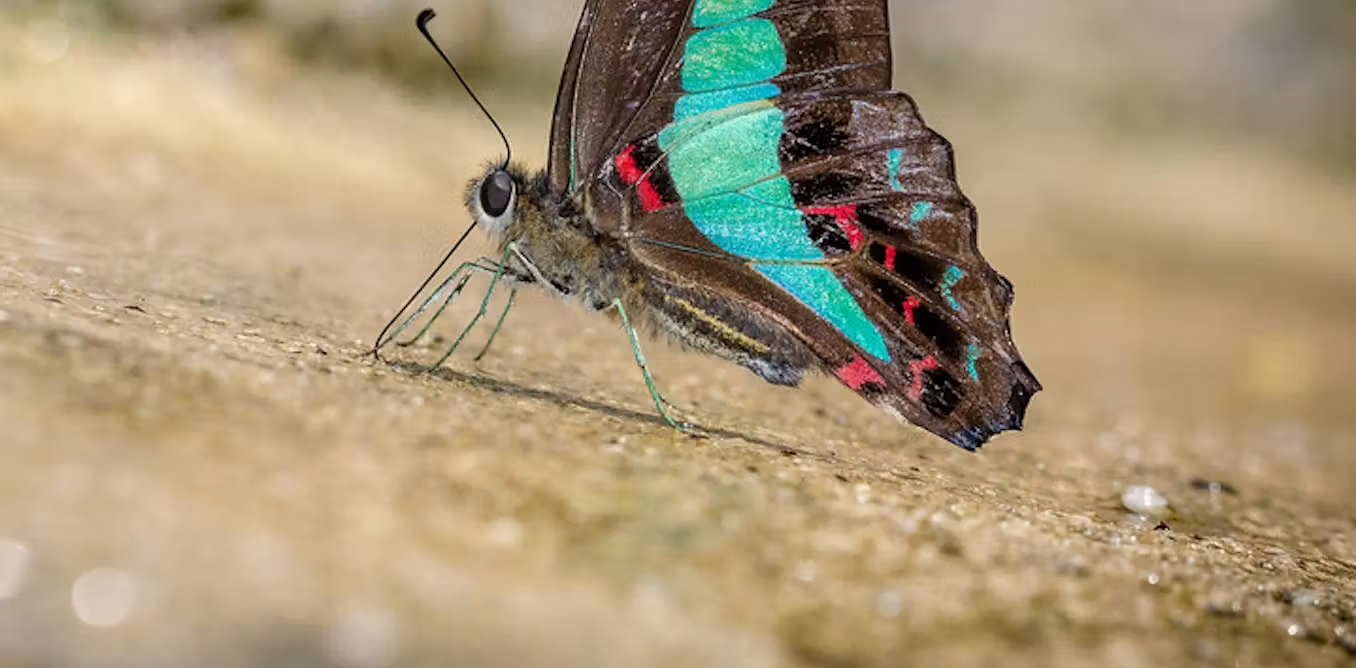
Imagine spotting a butterfly species in your garden you have never seen before. You might take a photo and upload it to a citizen science app, or tell a local nature group about your new encounter. It feels like a small moment of joy.
But if that butterfly has appeared in your backyard because its old home is becoming too hot, too dry or too damaged, the sighting is more worrying.
Around the world, ongoing environmental changes are prompting many butterfly species to relocate and search for new homes, a process referred to as species range shifts or species redistribution. As temperatures, rainfall and habitats change, butterflies can relocate over long distances, or even move vertically up and down mountain ranges.
Our new global study found one in ten known butterfly species has already shifted in range. So, where are they going – and why?
Shawan Chowdhury
How do we know butterflies are on the move?
The data used in our global study was comprehensive: more than 6,180 reports of butterfly range shift from 565 studies and 68 expert assessments, which covered 1,758 species across 105 countries.
These showed 80% of the documented butterfly species had expanded their ranges latitudinally, meaning east to west, or longitudinally, meaning north to south. We found 27% had reduced their range and 22% had shifted up or down slopes on hills or mountains. Many species showed a combination of these range changes.
The public narrative is often simplistic: as the world warms, species are shifting towards cooler temperatures at higher latitudes, or moving upwards in mountains. This is happening, but it is only one piece of the puzzle.
In fact, butterflies need more than to find new homes at the right temperature. Caterpillars often depend on specific host plants; adults need nectar, shelter and safe places to breed; and populations also require connected habitats so individuals can move easily through the landscape, meet, reproduce and breed.
Change can come quickly
Some species show how fast changes can happen. The tawny coster (Acraea terpsicore) native to the Indian subcontinent, has expanded through Southeast Asia and into Australia. In Brazil, (Godartiana byses) has expanded from Rio de Janeiro and Bahia into São Paulo, a shift linked to climate warming.
Other species show the opposite pattern. The small blue (Cupido minimus) has lost 40% of its habitat in the United Kingdom over the past 150 years. In Germany, the cranberry fritillary (Boloria aquilonaris) has lost much of its original habitat because of bog drainage. In Romania, an increase in farming has been linked to a severe range contraction of the danube clouded yellow (Colias myrmidone).
Even range shifts along mountain slopes are not always straightforward. In Mexico, the painted lady (Vanessa cardui) shifted upslope at a rate of about 83 metres per year between 1988 and 2011. Over the same period, the queen butterfly (Danaus gilippus) shifted downslope at a rate of about 32m per year.
Together, these examples show butterfly species range shifts are not simply a story of animals moving towards the poles.

Shawan Chowdhury
What’s causing this change?
In our study, climate change and extreme weather events were the most common reasons why butterflies shifted their range. But climate change is not the only factor. Agriculture, forestry, urban development and habitat destruction are also reshaping where butterflies can live and reproduce. These disturbances destroy host plants and breeding sites, and fragment large habitats into patches too small to sustain a healthy population.
Europe and North America have many long-term butterfly monitoring programs, run by expert volunteers and citizen scientists. We found that in some European countries, range shifts have been documented for more than half the national butterfly species. But in most countries, records exist for fewer than 10% of known butterfly species.
We know the least about butterflies in Central Africa, Southeast Asia, New Guinea and the Amazon Basin, some of the richest places on Earth for biodiversity.
They are also places where many species may already live close to their upper thermal limits. Even small increases in temperature can make parts of their habitat unsuitable.
Supporting experts and volunteers to develop citizen science monitoring programs would better protect butterflies in these megadiverse countries.

Shawan Chowdhury
Why this matters
Why should people care? Butterflies are part of the living fabric around us. Adult butterflies contribute to pollination. Caterpillars feed birds, spiders and other insects. When butterflies disappear, it can signal the plants, grasslands or woodlands once visited by butterflies are also changing.
This matters for conservation. Many protected areas are based on maps of where species lived in the past. But if butterflies and other species are moving, those maps quickly become outdated.
The message is simple. Conservation cannot only protect habitats where species once lived – it must include the places where they will relocate, and the wildlife corridors they will use to get there. If not, we may keep protecting yesterday’s nature while tomorrow’s nature has nowhere left to go.

Aletta Bonn is member of the German Advisory Council on Global Change (WBGU).
Jonathan Lenoir and Shawan Chowdhury do not work for, consult, own shares in or receive funding from any company or organisation that would benefit from this article, and have disclosed no relevant affiliations beyond their academic appointment.
Click here to view the original article.
Author/s: Shawan Chowdhury, Head of Global Change Ecology Lab, Monash University
